
Tree Diversity, Carbon Storage and Carbon Dioxide Sequestration Assessment in Dry Evergreen Forest and Mixed Deciduous Forest of Selected Botanical Gardens and Arboreta in Thailand
DOI:
https://doi.org/10.34044/tferj.2026.10.1.6673Keywords:
Carbon Storage, carbon dioxide sequestration, protected areas, allometric equationAbstract
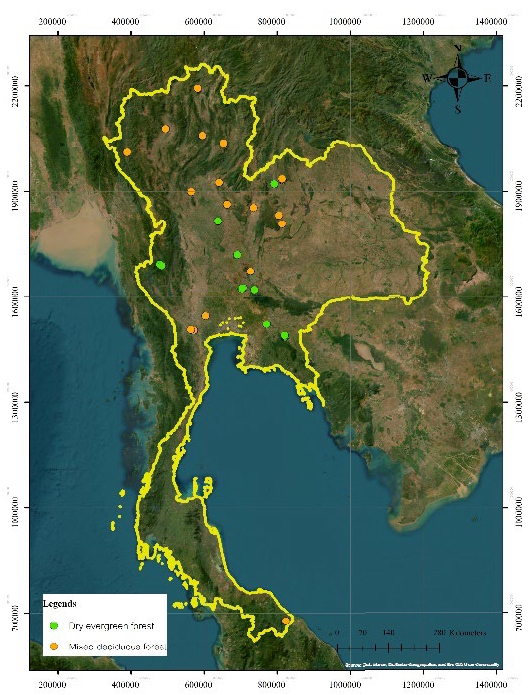
Background and Objectives: The increase in greenhouse gases concentrations is a major driver of climate change, which in turn affects to forest ecosystems. Forest plays a role in the release and storage of carbon, thereby influencing global warming. However, forest ecosystems also mitigate climate change by absorbing carbon dioxide through various processes and serve as reservoirs of biodiversity for both flora and fauna. In Thailand, the forests mostly are tropical dry forests and forests can be categorized into two types; 1) deciduous forests (such as deciduous dipterocarp forest and mixed deciduous forest) and 2) evergreen forests (such as dry evergreen forest, montane forest and moist evergreen forest). These two types of forest are distributed throughout the country, with most found in protected areas. Botanical gardens and arboreta are classified as urban forest that there are people using regularly and serve as important sites in protected areas. It comprised many rare or economically valuable plant species and also serves as a biodiversity conservation area and a research site but less documents were found in species diversity and the potential of carbon stock and carbon dioxide (CO2) sequestration. This study aimed to clarify species diversity in dry evergreen forest (DEF) and mixed deciduous forest (MDF) within selected botanical gardens and arboreta and study the potentials of botanical gardens and arboreta as carbon storage.
Methodology: A total of 241 concentric sample plots were established in 2024 with inter-plot spacing of either 250 m or 2.5 km, depending on the size of the botanical gardens and arboreta and are divided into 115 sample plots within dry evergreen forest, covering an area of 11.5 ha, and 126 sample plots within mixed deciduous forest, covering an area of 12.6 ha. Concentric sample plots with radius about 17.84 m were established. All trees with diameter breast height (DBH) >4.5 cm and height greater than 1.3 m were tagged, identified and mapped azimuth. The data was used to calculate aboveground biomass using allometry equations, and the resulting aboveground biomass were used to quantify belowground biomass, carbon storage and carbon dioxide (CO2) sequestration.
Main Results: The results revealed that 19, 514 individuals were found. In DEF contained 10,139 individuals across 481 species with 268 genera and 78 family and the dominant species based on importance value index (IVI) was Dipterocarpus alatus with 15.54 and followed with Streblus asper, Afzelia xylocarpa, Eucalyptus camaldulensis and Delonix regia, with species diversity and species richness index was 4.96 and 52.80 respectively. While, MDF contained 9,375 individual of trees across 406 species with 243 genera and 77 family and the dominant species based on IVI was Tectona grandis with 19.84 and followed with Pterocarpus macrocarpus, Xylia xylocarpa, Combretum quadrangulare and Streblus asper, with species diversity index and species richness index was 4.99 and 44.28 respectively. Carbon storage and carbon dioxide (CO2) sequestration assessment were estimated using allometry equation. Biomass in DEF and MDF were 190.18 t/ha and 142.26 t/ha, respectively, Carbon storage in DEF and MDF were 89.38 tC/ha and 66.86 tC/ha, respectively and Carbon dioxide (CO2) in DEF and MDF were 328.04 tCO2/ha and 245.38 tCO2/ha, respectively. Diameter class distribution in both communities exhibited a negative exponential pattern, indicating stable population structure. The high proportion of small-sized trees suggests strong regeneration potential, with many individuals likely to develop into mature trees in the future. Furthermore, in terms of carbon storage potential, larger trees (DBH > 30 cm) had the larger of carbon storage, even though there are less number of trees in the group. However, small to medium sized trees can still grow into mature trees in the future, thereby enhancing future carbon storage potential. A t-test was used to compare the mean of biomass, carbon storage and carbon dioxide (CO2) sequestration indicated that two forest types is non-significant (p-value = 0.22) in potentials of carbon storage and carbon dioxide (CO2) sequestration.
Conclusion: This study highlights the potential of botanical gardens and arboreta to function as large carbon storage area. This study indicates that many tree species within natural forests had high potentials of carbon storage and carbon dioxide (CO2) sequestration. The results can serve as a valuable database for assessing carbon storage in botanical gardens and arboreta. Furthermore, this study can inform conservation planning within these areas. Effective management should prioritize not only the preservation of large trees but also keep smaller trees with the potential to develop into larger trees in the future, thereby enhancing overall carbon storage potential. In addition, future monitoring of the dynamics within the sample plots may provide greater clarity changes in tree populations and their impact of potential of carbon storage in botanical gardens and arboreta. Overall, our findings can support the sustainable management of botanical gardens and arboreta, contributing to their role towards a low-carbon society.
Downloads
References
Becker, F.S., J. A. Slingsby, J. Measey, K. A. Tolley & R. Altwegg. 2022. Finding rare species and estimating the probability that all occupied sites have been found. Ecological Applications 32(2): e2502. https://doi.org/10.1002/eap.2502
Chaiyo, U., S. Garivait & K. Wanthongchai. 2012. Structure and Carbon Storage in Aboveground Biomass of Mixed Deciduous Forest in Western Region, Thailand. GMSARN International Journal 6: 143-150.
Chandaeng, W., L. Puangchit & N. Jumwong, 2018. Structure and Carbon Sequestration of Natural and Economics Forest at Wang Nam Khiao Forestry Research and Student Training Station, Nakhon Ratchasima Province. Thai Forest Ecological Research Journal 2(1): 17-25. (in Thai)
Chandaeng, W., L. Puangchit, N. Junkerd & N. Jumwong. 2020. Carbon Stock of Different Forest Communities at Wang Nam Khiao Forestry Research and Student Training Station Nakhon Ratchasima Province. Thai Journal of Forestry 39(1): 57-70. (in Thai)
Corlett, R.T., 2016. The impacts of droughts in tropical forest. Trends in Plant Science 21(7); 584-593. https://doi.org/10.1016/j.tplants.2016.02.003
Curtis, J.T., 1959. The Vegetation of Wisconsin: An ordination of plant communities. University of Wisconsin Press, Madison.
Department of National Parks, Wildlife and Conservation. 2019. Botanical Gardens and Arboretum. Available source: https://botany.dnp.go.th/garden/index.html. (Accessed: December 18, 2025)
Forest Survey and Assessment Division. 2022. Forest Inventory Guideline. Forest and Plant Conservation Research Office, Department of National Parks, Wildlife and Conservation, Bangkok.
Gebeyehu, M. N. & F. H. Hirpo. 2019. Review on Effect of Climate Change on Forest Ecology. International Journal of Environmental Sciences and Natural Resources 17(4): 126-129. https://doi.org/10.19080/IJESNR.2019.17.555968
Giam, X. 2017. Global biodiversity loss from tropical deforestation. In Proceedings of the National Academy of Sciences of the United States of America 114: 5775-5777.
IPCC. 2006. IPCC Guidelines for National Greenhouse Gas Inventories. IGES, Hayana, Japan.
Kaewbanlao, W., P. Sunthornhao & P. Lumyai. 2025. Tree diversity and carbon sequestration assessment using multiple methods in a dry evergreen forest restoration site, Nakhon Ratchasima, Thailand. Biodiversitas Journal of Biological Diversity 26(8): 3886-3902. https://doi.org/10.13057/biodiv/d260820
Kanhom, B., B. Moungsrimuangdee, P. Waiboonya, P. Yodsa-nga & P. Larpkern. 2019. Plant Diversity and Biomass Carbon Stocks of Nong Mek Community Forest, Khok Sung District, Sa Kaeo Province. Thai Journal of Forestry 38(2): 41-55. (in Thai)
Kanthawong, T., N. Leksungnoen & S. Uthairatsamee. 2024. Carbon Storage in Tree at Nature Trail in The Initiative of Her Majesty Queen Sirikit Nakhon-Sawan Province. Science and Technology Nakhon Sawan Rajabhat University Journal 16(24): 12-27. (in Thai)
Koonkhunthod, N., 2021. An Important Role of Protected Area as the Carbon Sink: A Case Study of Comparison of Carbon Storage in Sub Lang Ka Wildlife Sanctuary and Permanent Forest Area, Lopburi Province. source: https://readcard.dnp.go.th/km/docs/%20PSK.pdf. (Accessed: May 29, 2026) (in Thai)
Krebs, C.J., 1999. Ecological Methodology (2nd). Addison Wesley Longman, California.
Margalef, R., 1958. Information theory in ecology. General Systematic 3: 36-71.
Marod, D. & U. Kutintara. 2009. Forest Ecology. Faculty of Forestry. Aksornsiam Press, Bangkok.
Marod, D., U. Kutintara, Y. Chanchai, H. Tanaka and T. Nakashizuka. 1999. Structural dynamics of a natural mixed deciduous forest in western Thailand. Journal of Vegetation Science 10: 777-786. https://doi.org/10.2307/3237302
Marod, D., P. Duengkae, S. Sangkaew, P. Racharak, W. Suksavate, S. Uthairatsamee, L. Asanok, S. Thinkampheang, S. Hermhuk, P. Kachina, J. Thongsawi, W. Phumpuang, P. Paansri, W. Nuipakdee, P. Nakmuenwai & S. Pattanakiat. 2022. Population Structure and Spatial Distribution of Tree Species in Lower Montane Forest, Doi Suthep-Pui National Park, Northern Thailand. Environment and Natural Resources Journal 20(6): 644-663. https://doi.org/10.32526/ennrj/20/202200139
Narknoi, N., S. Banjay, K. Phongkaranyaphat, W. Singyoocharoen, W. Mangkita, M. Banjongkarn, K. Krueama & L. Asanok. 2022. Plant Community Characteristics and Soil Factors of Mixed Deciduous Forest in Ban Pong Community Forest, Long District, Phrae Province. Thai Journal of Forestry 41(2): 93-108. (in Thai)
Nguyen, T. V., R. Mitlohner, N. V. Bich & T. V. Do. 2015. Environmental factors affecting the abundance and presence of tree species in a tropical lowland limestone and non-limestone forest in Ben En National Park, Vietnam. Journal of Environmental Sciences 31(3): 177-191. https://doi.org/10.7747/JFES.2015.31.3.177
Nuanurai, N. 2005. Comparison of leaf area index, above-ground biomass and carbon sequestration of forest ecosystems by forest inventory and remote sensing at Kaeng Krachan National Park, Thailand. M.Sc. thesis, Faculty of Science, Chulalongkorn University. Bangkok. (in Thai)
Ogawa, H., K. Yoda, K. Ogino & T. Kira. 1965. Comparative ecological studies on three main types of forest vegetation in Thailand. II. Plant biomass. Nature and Life in Southeast Asia 4: 49-80.
Petsri, S., M. Pumijumnong, C. Wachrinrat & S. Thoranisorn. 2007. Aboveground Carbon Content in Mixed Deciduous Forest and Teak Plantations. Environment and Natural Resources Journal 5(1): 1-10.
Phumphuang, W., D. Marod, S. Sungkaew & S. Thinkampaeng. 2018. Forest Dynamics and Tree Distribution Patterns in Dry Evergreen Forest, Northeastern, Thailand. Environment and Natural Resources Journal 16(2): 58-67. https://doi.org/10.14456/ennrj.2018.15
Phumphuang, W., S. Sungkaew, C. Wachrinrat, S. Thinkampheang, S. Hremhuk, J. Thongsawi, S. Waengsothorn, L. Lin & D. Marod. 2024. Environmental factors differentially influence species distributions across tree size classes in a dry evergreen forest in Sakaerat Biosphere Reserve, northeastern Thailand. Journal of Forest Research 29(4): 297-305. https://doi.org/10.1080/13416979.2024.2314834
Piankhit, P., K. Panngom, M. Nosaengsri, K. Kruama, S. Somprakon, W. Srikue, N. Jumwong, P. Sanvisitpirom & L. Asanok. 2567. Vegetation Struture Characteristics and Carbon Stock of Mixed Deciduous Forest in Protected Area of Teak (Tectona grandis) Plantation, North Forest Industry Organization. Thai Forest Ecological Research Journal 8(2): 467-486. (in Thai)
Poorter, L., M. T. van der Sande, J. Thompson, E. J. M. M. Arets, A. Alarcón, J. Álvarez-Sánchez, N. Ascarrunz, P. Balvanera, G. Barajas-Guzmán, A. Boit, F. Bongers, F. A. Carvalho, F. Casanoves, G. Cornejo-Tenorio, F. R. C. Costa, C. V. de Castilho, J. F. Duivenvoorden, L. P. Dutrieux, B. J. Enquist, F. Fernández-Méndez, B. Finegan, …, M. Peña-Claros. 2015. Diversity enhances carbon storage in tropical forests. Global Ecology and Biogeography 24(11): 1314-1328. https://doi.org/10.1111/geb.12364
Rihan, A., R. A. Begum, M. N. M. Said & J. J. Pereira. 2021. Assessment of Carbon Stock in Forest Biomass and Emission Reduction Potential in Malaysia. Forests 12: 1294. https://doi.org/10.3390/f12101294
Saikhammoon, R., S. Sungkaew, S. Thinkampaeng, W. Phumphuang, T. Kamyo & D. Marod. 2023. Forest Restoration in an Abandoned Seasonally Dry Tropical Forest in the Mae Klong Watershed, Western Thailand. Environment and Natural Resources Journal 21(5): 443-457. https://doi.org/10.32526/ennrj/21/20230121
Santisuk, T. 2012. Forest of Thailand. National Office of Buddhism. Bangkok.
Sun, L. & D. S. Guan. 2014. Carbon stock of the ecosystem of lower subtropical broadleaved evergreen forests of different ages in Pearl River Delta, China. Journal of Tropical Forest Science 26(2): 249-258.
Terakunpisut, J., N. Gajaseni & N. Ruankawe. 2007. Carbon sequestration potential in aboveground biomass of Thong Pha Phum National Forest, Thailand. Applied Ecology and Environmental Research 5(2): 93-102.
Thongnun, J., P. Lumyai, S. Suksard & S. Sriarkarin. 2022. Forest Dynamics and Carbon Stock over a 10-year Period at Lam Nam Nan National Park in Uttaradit and Phrae Provinces. Thai Journal of Forestry 41(2): 48-62. (in Thai)
Tsutsumi, T., K. Yoda, P. Sahunalu, P. Dhammanonda & B. Prachaiyo. 1983. Forest: felling, burning and regeneration. pp. 13-26. In K. Kyuma and C. Pairitra (eds.). Shifting cultivation. Tokyo.
Yatar, C., S. Thinkampheang, S. Sungkaew, C. Wachrinrat, L. Asanok, T. Kamyo, S. Hermhuk, P. Kachina, J. Thongsawi, W. Phumphuang, A. Yarnvudhi, S. Waensothorn, S. Cheysawat & D. Marod. 2024. The dynamics of deciduous dipterocarp forest in relation to climate variability in the Sakaerat Biosphere Reserve, Northeastern Thailand. Biodiversitas Journal of Biological Diversity 25(7): 3088-3098. https://doi.org/10.13057/biodiv/d250730
Zhang, J., H. Li, J. Wang, Y. Liang, R. Li, R. Li & X. Sun. 2024. Exploring the Differences in Tree Species Classification between Typical Forest Regions in Northern and Southern China. Forests 15(6): 929. https://doi.org/10.3390/f15060929
Downloads
Published
Issue
Section






.png)